Why Grackle Docs' ADA Model Fails Universities
In the quest for ADA compliance, many universities default to legacy solutions like Grackle Docs. At first glance, it seems like a safe bet. However, for institutions looking to empower their faculty and staff while managing costs, there is a fundamental flaw in the Grackle model that is becoming increasingly apparent in the age of AI.
Who this matters to
- Disability services and accessibility teams
- Instructional designers and faculty development teams
- Procurement and compliance leaders
- Departments producing large volumes of course materials
The "Checker" vs. The "Fixer"
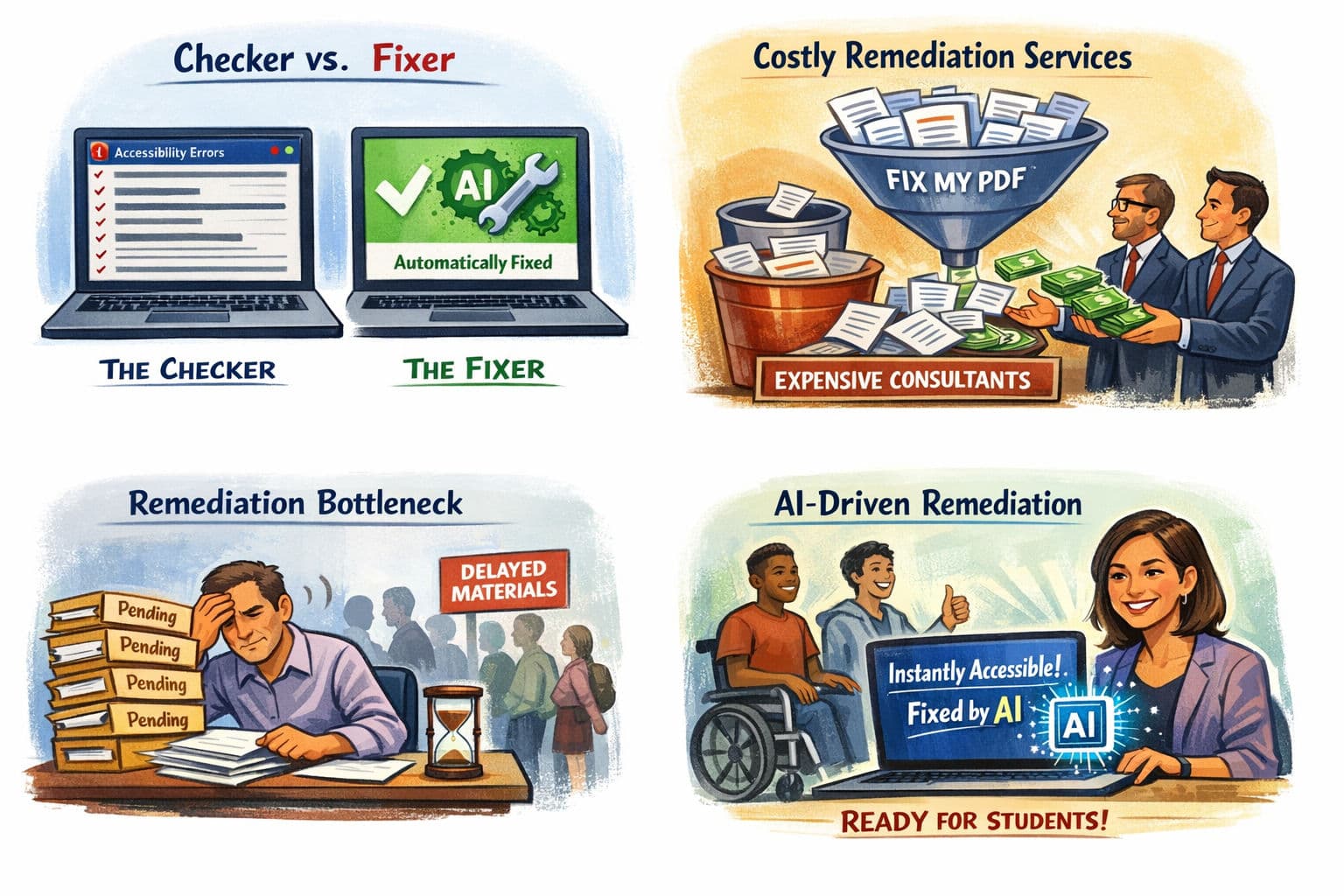
The core issue with Grackle Docs is its product philosophy. Grackle is primarily a checker. It identifies errors and presents a list of problems to the user. For a busy professor managing four courses and research, a list of 50 accessibility errors isn't a solution—it's another item on an already impossible to-do list.
What the side-by-side test shows
In a separate test using the exact same document in both tools, Grackle identified some accessibility issues but left more of the interpretation and remediation to the user. Inkable provided more context and guided the user toward specific fixes.
- Grackle missed an equation that was visibly present, while Inkable detected it and generated a description.
- Grackle passed a manually formatted list, while Inkable recognized and converted it into a native list.
- Inkable evaluated heading context instead of only flagging the number of Heading 1s.
The Hidden Upsell
Grackle's software often feels like a lead generation tool for their true business: Remediation Services.
Because the workflow leaves much of the fixing to the user, universities can be funneled into expensive remediation contracts where they pay consultants to fix documents manually. This model relies on "cross-selling" and "up-selling" services that should be handled by the technology itself.
Why Remediation isn't Scalable
Hiring consultants to fix PDFs after they are created is a reactive strategy that cannot scale. Every semester, faculty generate thousands of new syllabi, lecture notes, and research papers. Relying on an external service to remediate these documents creates:
- Bottlenecks: Course materials aren't ready when students need them.
- Financial Drain: Costs grow linearly with the volume of content.
- Institutional Dependency: The university becomes locked into a cycle of paying for services instead of building internal capability.
The AI Revolution: Ending the Remediation Tax
In 2025, paying humans to manually tag PDFs is like paying a scribe to copy books in the age of the printing press. Inkable Docs was built from the ground up to utilize AI to handle the remediation within the product.
Automation reduces repetitive work, but accessibility decisions should still be reviewed by the document owner or an accessibility professional when the content is complex.
Automated Remediation
Inkable doesn't just point out missing alt-text or broken table structures; it fixes them using AI, saving faculty hours of manual labor.
Lower Total Cost
By moving the "fix" to the software, you eliminate the need for expensive third-party remediation services.
Empowering Faculty, Not Burdening Them
True ADA compliance happens at the point of creation. Inkable Docs provides an interface that is so intuitive that professors can make their documents accessible without ever needing to learn the technical requirements of WCAG or PDF/UA.
Unlike Grackle, which often requires a "power user" to navigate its clunky interface, Inkable is designed for the layman. It integrates seamlessly into the Google Docs workflow, providing helpful interventions that feel like a companion rather than a critic.
The "Wait Time" Penalty
When a university relies on manual remediation services, they are inadvertently creating a two-tiered educational experience. Students without disabilities get their course materials the moment they are uploaded. Students with disabilities, however, often have to wait days or weeks for those same documents to be "remediated" by an external service.
Inkable Docs is designed to reduce that delay. Because issues can be identified and addressed inside the authoring workflow, a more accessible version can be reviewed before course materials are published. There is less "wait time" for inclusion.
Building Institutional Culture
Legacy tools like Grackle Docs treat accessibility as a post-production chore. This mindset ensures that faculty never actually learn how to write accessible content. They simply wait for the checker to complain and then either struggle through manual fixes or hand it off to a consultant.
Inkable Docs acts as a silent tutor. Our sidebar provides real-time guidance that teaches faculty best practices as they work. Over time, this builds a culture of accessibility within the institution, making compliance a natural part of the creative process rather than a technical hurdle to be cleared later.
Privacy and Data Sovereignty
In the modern academic environment, data privacy is paramount. When documents are sent out for manual remediation, they often leave the university's secure Google Workspace environment to be handled by third-party contractors. This introduces unnecessary risks for sensitive research data and student information.
With Inkable Docs, remediation can happen inside the authoring workflow, reducing the need to send documents to third-party contractors. Institutions should still review the product's privacy and data-handling terms for their deployment.
Break Free from the Remediation Cycle
Stop paying for checks that lead to more bills. Switch to the AI-powered solution that actually fixes your documents and empowers your entire campus.
For a detailed six-check product comparison, read our Inkable Docs vs. Grackle Docs comparison or watch the accompanying side-by-side video.